Kruczek-Finder
A document-review prototype using OCR and text similarity to flag potentially problematic contract clauses for inspection.
Original project evidence
Explore the project.
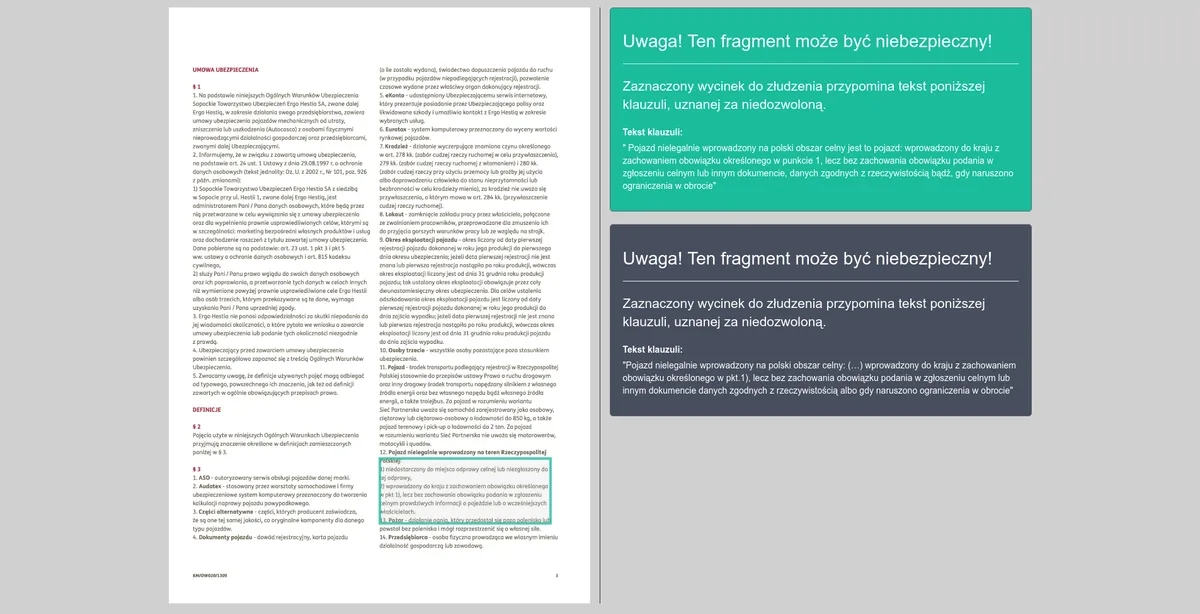
01Read a document+
The historical app accepts photographs, scans, or PDFs and extracts text with OCR.
02Compare clauses+
Text similarity is used to find passages resembling clauses in a reference dataset.
03Review highlights+
The output flags suspicious fragments for human inspection; this is not legal advice or a live document analysis.
Making suspicious clauses easier to inspect
Kruczek-Finder accepts a photographed or scanned document, or a PDF, and aims to highlight fragments that resemble potentially problematic contract clauses. Its documented flow ends with an emailed link to a review view.
Implementation
The README identifies Tesseract for OCR, Levenshtein-based similarity, and a public-data source of clauses. The Django application therefore combines document ingestion, text extraction, matching, and a result-review interface.
Scope and limitations
A similarity match is a reason to inspect a passage—not a legal conclusion, a completeness guarantee, or a substitute for professional advice. This portfolio deliberately does not repeat the original README's broad claim about finding all potential threats.
The walkthrough describes the original stages. A restored UI should use a bundled fictional document and visible sample matches, without accepting visitors' contracts, storing private documents, or sending email.
Recognition
- Winner of WawCode, Fall Edition — WawCode, Oct 2016